Surpasses monolithic limitations using adaptive test-time compute, delivering the precision required for mission-critical industrial tasks.
Delivers frontier intelligence with significantly lower computational overhead and GPU memory requirements.
Running on a single GPU, it enables infrastructure-agnostic deployment via containerized delivery, optimized for sovereign enterprise-grade environments.
Ensures full ownership of your data and model pipeline, reducing vendor dependency and securing full business continuity.
The platform provides centralized logging across all services and components, making it easier to detect bugs, investigate failures, and troubleshoot complex workflows. It also offers visibility into access patterns, so teams can see who is accessing which resources and when.
A built-in authorization layer allows administrators to define which roles can access which resources and operations. This ensures consistent access control across the platform and helps enforce security and governance policies.
The platform includes a centralized metrics stack based on VictoriaMetrics to collect, store, and visualize operational metrics. This gives teams a unified view of infrastructure and workload performance, including resource usage such as GPU consumption.
The platform supports two complementary execution flows. The offline flow is designed for AI development activities such as model building, training, hyperparameter search, and benchmarking, while the online flow is dedicated to deploying and orchestrating agentic systems in production. Flows are orchestrated via Airflow and are fully configurable via a yaml file.
A chat interface allows users to interact directly with the agents and tools orchestrator in a simple and intuitive way. This makes it easier to trigger actions, inspect system behavior, and communicate with the platform without relying only on low-level operational tools.
The platform uses Kafka as its real-time streaming backbone, with the orchestrator publishing all relevant actions and events. Multiple consumers, including the chat interface, can subscribe to these streams to provide full visibility into what is happening across agents and workflows.
User and identity management are handled through Keycloak, providing a centralized way to manage users, roles, and authentication policies. It also supports integration with external identity providers, enabling federated access and smoother enterprise adoption.
Training, inference, and model serving workloads are executed on Ray, which provides a scalable distributed compute framework for AI workloads. Integrated profiling capabilities also help teams analyze performance and optimize execution efficiency.
AI-specific metrics and experiment data are collected in MLflow, giving teams a structured environment for tracking runs, parameters, and results. This improves reproducibility and makes it easier to compare models and monitor experimentation outcomes over time.
The platform includes monitoring tools and dashboards to track the health and status of services in real time. Automated health checks verify that critical components are running correctly, and alerting mechanisms can notify teams by email when issues are detected.
Distributed tracing is centralized through Jaeger, allowing teams to follow requests and workflows across multiple services and components. This is especially useful for understanding end-to-end execution paths, identifying bottlenecks, and debugging complex orchestration behavior.
An integrated object storage layer acts as a shared network-accessible file system for AI artifacts. It is used to store and retrieve models, datasets, checkpoints, and intermediate results, ensuring that artifacts remain accessible across different stages of the workflow.
A simple python client to authenticate and communicate programmatically with our API gateway. From this client you can both configure and run offline and online flows as well as interact with the agentic orchestrator.
Giotto is the next generation portable AI model. Built to enable agentic reasoning on a single GPU, it can run on the infrastructure of your choice.
At its core, Giotto is a foundation AI model designed around a fundamentally different paradigm: not a single monolithic architecture, but a coordinated network of smaller, specialized models working together. Inspired by distributed intelligence principles, it breaks down complex reasoning into modular components that collaborate dynamically, enabling greater flexibility, transparency, and control.
This architecture is further enhanced by adaptive test-time compute, allowing the system to scale reasoning depth in real time based on task complexity. Instead of overcommitting resources, it intelligently allocates compute where it matters most, improving both efficiency and accuracy.
The result is a foundation that is not only portable across environments, but also inherently scalable, auditable, and resilient, purpose-built for enterprise-grade AI systems that demand precision, adaptability, and trust.
Giotto enables the creation of highly specialized agents tailored to specific business domains, use cases, and operational needs. Rather than relying on generic intelligence, teams can design agents with focused expertise, ensuring higher accuracy, better performance, and more predictable outcomes.
This specialization is supported by flexible development workflows and programmatic interfaces that make it easy to configure, test, and refine agent behavior. As a result, organizations can build a portfolio of purpose-driven agents that align closely with their processes, unlocking greater efficiency and enabling more precise automation across complex tasks.
Giotto provides a powerful orchestration layer that enables multiple agents to work together seamlessly. It supports event-driven coordination, allowing agents to communicate, react, and execute tasks in real time as part of dynamic workflows.
With intuitive interaction capabilities, including conversational interfaces, users can easily trigger actions, monitor behavior, and guide execution without needing deep technical intervention. This approach transforms isolated agents into collaborative systems, capable of handling complex, multi-step processes while maintaining transparency and control throughout the entire execution flow.
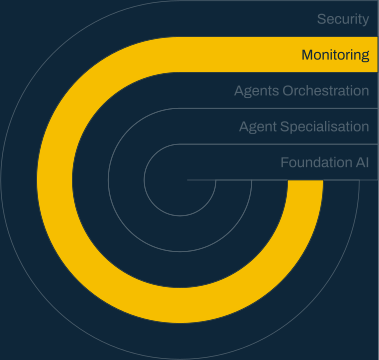
Full visibility is built into every layer of execution, ensuring that teams always understand how workloads are performing. The model provides centralized insights into resource usage, system health, and operational performance, enabling proactive management of both infrastructure and AI processes.
Advanced monitoring capabilities include real-time dashboards, automated health checks, and intelligent alerting, allowing teams to quickly identify and resolve issues before they impact operations. Combined with end-to-end tracing, this ensures that even the most complex workflows remain transparent, measurable, and continuously optimizable.
Giotto ensures that every interaction and operation is controlled, traceable, and compliant. A robust access control system enables organizations to define who can access what, enforcing consistent policies across all components and workflows.
Comprehensive logging captures every event, action, and access pattern, providing a complete audit trail for debugging, monitoring, and compliance purposes. With integrated identity management and support for federated authentication, the model fits seamlessly into enterprise environments while maintaining the highest standards of security, accountability, and operational trust.
Giotto provides the intelligence layer that enables end-to-end agentic systems.
Our technology significantly outperforms open-source AI models.
Placeholder
1. LongT5-TGlobal-Base 200M. / 2. Llama 3.2 1B.
Have a question for us? Please fill out the form below, and our team will get back to you promptly.